
 By
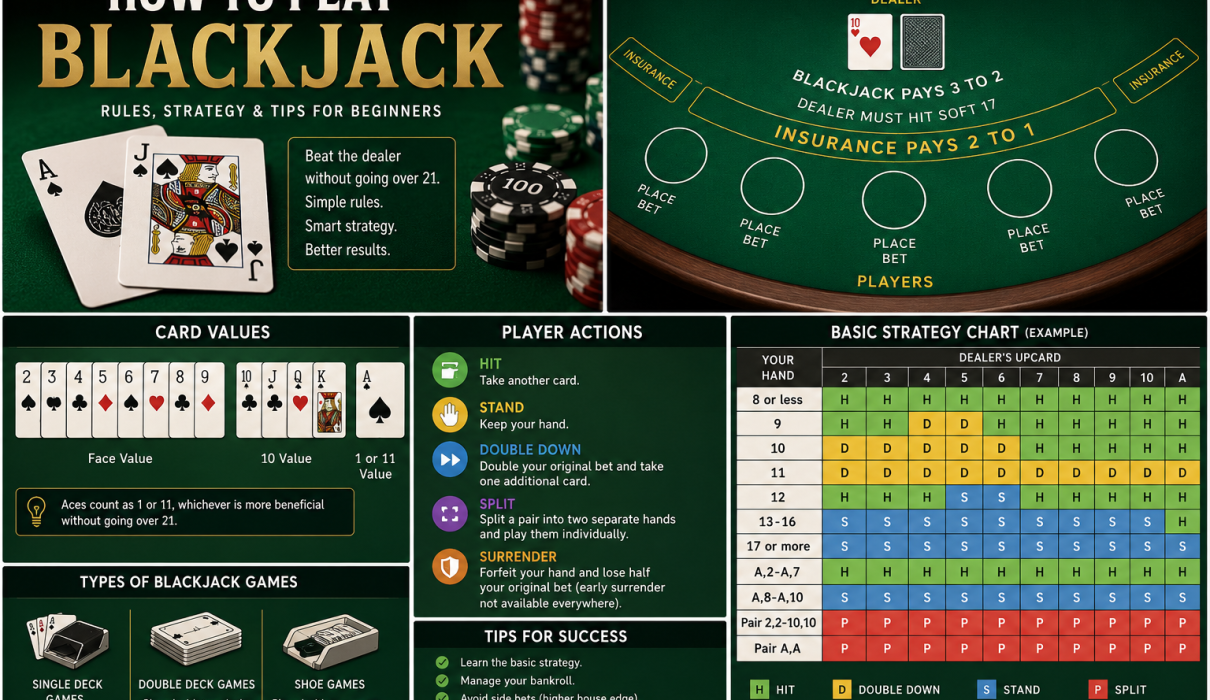
By If you want to learn how to play blackjack, start with the simple goal: get a hand value closer to 21 than the dealer without going over. Blackjack is one of the most popular casino card games because the rules are easy to learn, but the decisions give players more control than many other casino games.
This beginner’s guide explains the blackjack game, blackjack rules, card values, basic strategy, blackjack side bets, blackjack tables, blackjack variants, double down decisions, card counting basics, and the house edge in a clear way.
Table of Contents
What Is Blackjack and Why Is It One of the Most Popular Casino Games?
Blackjack is a comparing card game between the player and the dealer. Other players may sit at the same table, but each player plays against the dealer’s hand, not against one another. The player wins when their hand is closer to 21 than the dealer’s hand, when the dealer busts, or when the player blackjack beats a non-blackjack dealer hand.
How the Blackjack Game Works in Online and Land-Based Casinos
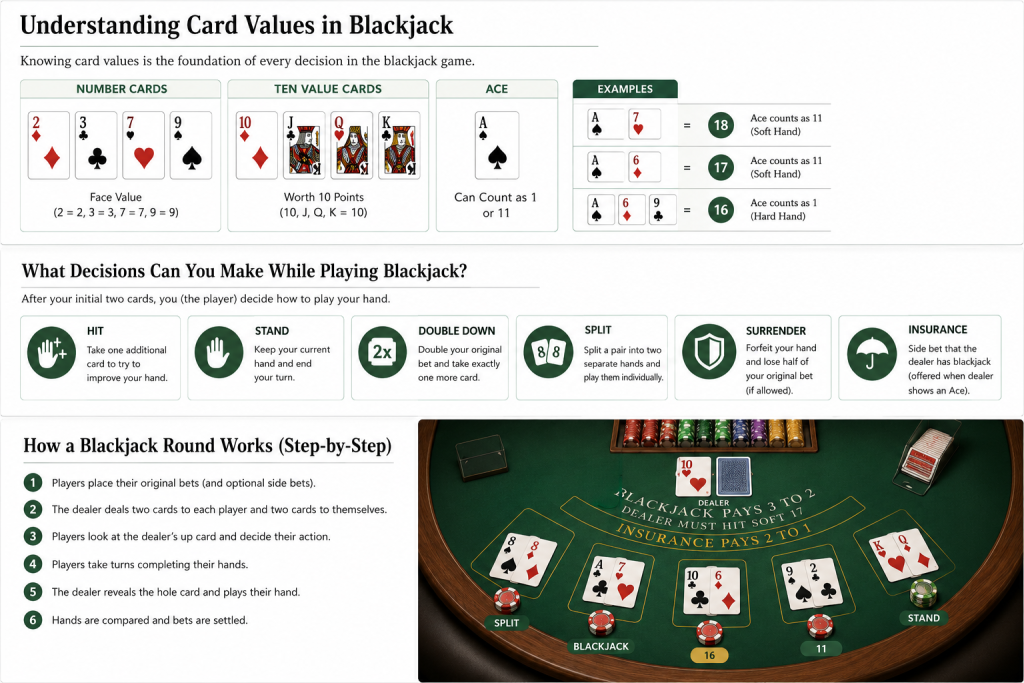
In most casinos, blackjack begins when players place casino chips or an online wager in the betting area. The dealer deals two cards to each player and two cards to themselves. Depending on the table rules, the cards are dealt face up or partly face down.
The player then decides whether to hit, stand, double down, split, or sometimes surrender. After all blackjack players finish their hands, the dealer reveals the hidden card, also called the hole card, and completes the dealer’s hand based on fixed rules.
Why Millions of Players Play Blackjack Worldwide
People play blackjack because it combines luck, rules, and decision-making. Unlike many casino games where the player only places a bet and waits, blackjack allows the player to make choices after seeing the dealer’s up card and their own two cards.
Blackjack is popular because:
- The main rules are easy to understand.
- The house edge can be low with basic strategy.
- Players can use logic instead of guessing.
- Games are available at land-based and online casinos.
- Many blackjack variants offer different table rules and betting styles.
How Blackjack Compares to Other Casino Card Games
Blackjack is different from poker because players do not compete against each other. It is different from baccarat because the player decides how to play the hand. It is different from pure chance card games because basic strategy can reduce mistakes and improve long-term results.
In blackjack, the player’s decision matters. Whether the player hits, stands, splits pairs, or doubles down can change the outcome of the initial hand.
Where Blackjack Fits in the Casino Games Ecosystem
Blackjack belongs to the wider family of casino games that includes roulette, baccarat, poker, craps, slots, and live dealer games. It is usually considered one of the best starting points for beginners because the table layout is simple and the objective is clear.
Next, it helps to understand the actual round-by-round process before learning advanced strategy.
How to Play Blackjack Step-by-Step for Beginners
A blackjack round follows a clear order: place a bet, receive cards, make decisions, wait for the dealer’s hand, and settle the result. Once a player understands this sequence, the rest of the game becomes easier.
What Happens Before the Dealer Deals the Cards?
Before the dealer deals, each player places an original bet in the betting circle. In online blackjack, this is done by selecting a chip amount and confirming the wager. At physical blackjack tables, players place casino chips on the table layout.
The main wager must be placed before any cards are dealt. Side bets, if available, are also placed before the round starts.
Understanding the Layout of Blackjack Tables
Blackjack tables usually include:
| Table Area | What It Means |
| Betting circle | Where the original bet is placed |
| Side bet area | Where optional blackjack side bets are placed |
| Dealer area | Where the dealer’s cards are dealt |
| Player spots | Seats or positions for each player |
| Table rules display | Shows payouts, minimum bets, and dealer rules |
Table rules matter because they affect the house edge. For example, single deck game rules may differ from double deck games or shoe games using one or more decks.
How Players Receive Their Starting Cards
Each player receives two cards. In many online and land-based games, both player cards are dealt face up. The dealer also receives two cards, usually one card face up and one hole card face down.
The visible dealer card is called the dealer’s up card or dealer’s upcard. This card helps the player decide how to play their hand.
How the Dealer Deals Cards During Each Round
The dealer deals cards in order, usually starting from the dealer’s left and moving around the table. After all initial hands are dealt, players act one at a time.
When the player asks for an additional card, that action is called a hit. The player can keep hitting until they stand, reach 21, or go over 21.
What the Player Decides During a Blackjack Hand
The player decides between several actions:
- Hit: take one additional card.
- Stand: keep the current hand.
- Double down: place a second bet and receive one additional card.
- Split: divide two cards of the same value into separate hands.
- Surrender: give up the hand and lose half the original wager, if allowed.
- Insurance wager: a side bet offered when the dealer shows an ace.
Each decision should be based on the player’s total, the dealer’s up card, and the specific blackjack rules at the table.
How a Blackjack Round Ends and Winners Are Determined
A round ends after the dealer reveals the hole card and completes the dealer’s hand. If the dealer busts, remaining players win. If the dealer stands, each hand is compared against the dealer’s final total.
The player wins if they have a stronger hand than the dealer without exceeding 21. The player loses if they bust, if the dealer has a better hand, or if the dealer blackjack beats the player’s hand. A tie is called a push, and the original bet is returned.
Now that the gameplay flow is clear, the next step is understanding the official blackjack rules that control each decision.
What Are the Official Blackjack Rules Every Beginner Should Know?
Blackjack rules define how hands are valued, when the dealer hits or stands, how payouts work, and what happens in special situations such as blackjack, push, surrender, insurance, and splitting pairs. These rules can change slightly between casinos and blackjack variants.
What Is the Goal of the Blackjack Game?
The goal of the blackjack game is to beat the dealer by having a hand value closer to 21 than the dealer’s hand without going over 21. A hand over 21 is a bust, and the player loses immediately.
A natural blackjack happens when the first two cards are an ace and a ten value card. Ten value cards include 10s, jacks, queens, and kings.
What Happens If You Go Over 21?
If the player’s hand goes over 21, the player busts and automatically loses the main wager. This happens before the dealer completes their hand, so even if the dealer later busts, the player’s busted hand is already lost.
The only exception is when special rule variations apply in rare blackjack variants, but in standard blackjack, going over 21 means the hand immediately loses.
When Does the Dealer Have to Hit or Stand?
The dealer does not choose freely like the player. The dealer hits or stands based on fixed table rules. Most casinos require the dealer to hit until reaching at least 17.
Common dealer rules include:
| Dealer Rule | Meaning |
| Dealer stands on all 17 | Dealer stands on hard 17 and soft 17 |
| Dealer hits soft 17 | Dealer hits when the hand includes an ace counted as 11 |
| Dealer must hit 16 or less | Dealer takes another card until reaching 17 or higher |
These rule variations affect the house edge.
What Is a Push in Blackjack?
A push happens when the player and dealer have the same final hand value. For example, if the player has 20 and the dealer also has 20, the hand is a tie.
In a push, the dealer does not pay the player, and the player does not lose the original bet. The main wager is returned.
How Blackjack Payouts Work
Payouts depend on the result of the hand and the table rules.
| Result | Common Payout |
| Regular winning hand | 1:1 |
| Natural blackjack | Often 3:2 or 6:5 |
| Push | Original bet returned |
| Insurance bet wins | Usually 2:1 |
| Player loses | Original bet lost |
A 3:2 blackjack payout is usually better for players than a 6:5 payout because it reduces the casino advantage.
What Happens When Both the Player and Dealer Have Blackjack?
If the player and dealer both have blackjack, the result is usually a push. The player does not win extra money, but the original wager is returned.
If the dealer shows an ace or ten value card, many casinos allow the dealer to check for blackjack before players act. This is called a dealer checks rule.
Why Blackjack Rules Change Between Casinos and Variants
Blackjack rules change because casinos offer different versions of the game. A single deck game, double deck, double deck games, and shoe games may all have different rules. Some blackjack tables allow surrender, while others do not. Some allow doubling after splitting, while others restrict it.
These differences matter because they influence the house edge and the best basic strategy decisions.
Once the rules are understood, the next important entity is card values because every action depends on hand totals.
Understanding Card Values in Blackjack
Card values are the foundation of blackjack. Every hit, stand, double down, split, and insurance decision depends on the value of the player’s hand and the dealer’s up card.
How Number Cards Are Valued
Number cards keep their face value. A 2 is worth 2, a 7 is worth 7, and a 9 is worth 9.
For example:
| Cards | Hand Value |
| 5 + 3 | 8 |
| 7 + 9 | 16 |
| 10 + 8 | 18 |
These simple totals are called hard hands when no ace is counted as 11.
How Face Cards Work in Blackjack
Face cards are worth 10. Jacks, queens, and kings are all ten value cards. A 10, jack, queen, or king has the same value in blackjack.
This is why blackjack strategy often groups these cards together as “ten value card” situations.
Why Aces Are the Most Important Cards in Blackjack
An ace can count as 1 or 11, depending on which value helps the hand more. If a card is an ace and counting it as 11 does not bust the hand, it usually counts as 11.
Examples:
| Hand | Value |
| Ace + 7 | Soft 18 |
| Ace + 9 | Soft 20 |
| Ace + 10 | Blackjack |
| Ace + 6 + 10 | Hard 17 |
Aces count flexibly, which makes soft hands stronger and more adaptable.
Hard Hands vs Soft Hands Explained
A hard hand does not contain an ace counted as 11. A soft hand contains an ace counted as 11.
Examples:
| Hand Type | Example | Meaning |
| Hard hand | 10 + 6 | Total is fixed at 16 |
| Soft hand | Ace + 6 | Can be 7 or 17 |
| Blackjack | Ace + king | Natural 21 with two cards |
Soft hands are safer to hit because the ace can change from 11 to 1.
How Card Values Affect Every Decision You Make
Card values guide every blackjack decision. A hard 16 against a dealer’s upcard of 10 is very different from a soft 16 against a weak dealer card. A pair of aces is not played the same way as a pair of 10s.
Understanding card values prepares players to learn the available decisions during a hand.
What Decisions Can You Make While Playing Blackjack?
Blackjack gives players several choices after the initial hand is dealt. The best decision depends on the player’s total, the dealer’s up card, and the table rules.
When Should a Player Hit?
A player hits when they want one additional card. Hitting is common when the hand total is low or when the dealer shows a strong up card.
Beginners often hit when:
- The hand is 8 or less.
- The hand is 12 to 16 and the dealer shows 7 or higher.
- The player has a soft hand that can improve safely.
The goal is to improve the hand without busting.
When Should a Player Stand?
A player stands when they keep the current hand and take no more cards. Standing is common when the hand is strong or when the dealer is likely to bust.
Players often stand when:
- They have 17 or higher.
- They have 13 to 16 against a weak dealer up card.
- They have a strong made hand such as 19 or 20.
Standing does not guarantee a win, but it prevents the player from busting.
What Does Double Down Mean in Blackjack?
To double down means to place a second bet equal to the original bet and receive exactly one additional card. After that card, the hand ends for the player.
Double down is powerful because it lets the player increase the wager in favorable situations.
When Should You Double Down?
Players usually double down when the initial hand has strong improvement potential and the dealer’s up card is weak.
Common double down examples include:
| Player Hand | Dealer’s Up Card | Common Decision |
| 11 | 2 through 10 | Double down in many rulesets |
| 10 | 2 through 9 | Double down often |
| 9 | 3 through 6 | Double down often |
| Soft 16 to soft 18 | Weak dealer cards | Double in some situations |
The exact choice depends on basic strategy and table rules.
What Is Splitting in Blackjack?
Splitting pairs means dividing two cards of equal value into two separate hands. The player must place a second bet, usually equal to the original wager.
For example, if a player receives two 8s, they can split them into two separate hands and play each hand individually.
When Should You Split Pairs?
Some pairs should almost always be split, while others should rarely be split.
| Pair | Beginner Rule |
| Pair of aces | Usually split |
| Pair of 8s | Usually split |
| Pair of 10s | Usually stand |
| Pair of 5s | Usually play as 10, do not split |
Split aces often receive only one additional card per ace, depending on the casino rules.
What Is Insurance and Why Do Most Experts Avoid It?
Insurance is a side bet offered when the dealer shows an ace. The insurance wager usually costs half the original bet and pays if the dealer has blackjack.
Most experts avoid the insurance bet because it usually has a high house edge unless the player is using advanced card counting and knows the remaining deck is rich in ten value cards.
Surrender Rules Explained for Beginners
Surrender allows the player to give up the hand and lose only half the original wager. Early surrender happens before the dealer checks for blackjack, while late surrender happens after the dealer checks.
Many casinos do not offer surrender, but when it is available, it can reduce losses in difficult hands.
These player decisions become stronger when guided by basic strategy, which is the next core concept.
What Is Basic Strategy in Blackjack?
Basic strategy is a mathematically tested decision system that tells players the best move for each hand based on the player’s cards and the dealer’s up card. It does not guarantee a win on every hand, but it reduces long-term mistakes.
Why Basic Strategy Exists in Blackjack
Basic strategy exists because every blackjack decision has a better and worse option over time. The strategy is based on probability, card values, and dealer rules.
Instead of guessing, the player uses a chart that shows whether to hit, stand, double down, split, or surrender.
How Basic Strategy Reduces the House Edge
The house edge is the casino’s average mathematical advantage over the player. Blackjack has a low house edge when players use correct basic strategy.
Without strategy, beginners often make costly mistakes such as standing too early, taking insurance, or failing to double in strong situations.
How to Read a Blackjack Basic Strategy Chart
A basic strategy chart compares the player’s hand against the dealer’s upcard.
The chart usually includes:
- Hard totals
- Soft totals
- Pair splitting decisions
- Dealer up cards from 2 through ace
- Recommended actions such as hit, stand, double, split, or surrender
The player finds their hand on one side and the dealer’s up card across the top, then follows the recommended action.
Best Basic Strategy Tips for New Blackjack Players
Beginners should remember these practical tips:
- Always learn the table rules before playing.
- Avoid insurance unless you fully understand the odds.
- Do not split 10-value cards.
- Usually split aces and 8s.
- Double down when basic strategy recommends it.
- Stand on strong totals instead of chasing 21.
Common Basic Strategy Mistakes Beginners Make
Common mistakes include:
- Playing based on feelings instead of hand value.
- Assuming the goal is always to reach exactly 21.
- Copying other blackjack players at the table.
- Ignoring the dealer’s up card.
- Taking side bets without understanding the house edge.
- Forgetting that soft hands and hard hands need different decisions.
Why Strategy Changes Based on Dealer Upcards
The dealer’s up card is important because it shows whether the dealer may have a strong or weak final hand. A dealer showing 4, 5, or 6 is more likely to bust than a dealer showing 10 or ace.
That is why the player may stand on 13 against a dealer 6, but hit 13 against a dealer 10.
Basic strategy leads naturally into the house edge because every correct or incorrect decision affects the casino’s advantage.
What Is the House Edge in Blackjack?
The house edge is the average advantage the casino has over players across many hands. In blackjack, the house edge can be relatively low when players use basic strategy and choose favorable blackjack tables.
How Casinos Make Money From Blackjack
Casinos make money because the rules give the dealer structural advantages. The biggest advantage is that the player acts first. If the player busts, the player loses even if the dealer busts later.
Other rules, such as 6:5 blackjack payouts or dealer hits soft 17, can also increase the house edge.
How Blackjack Has One of the Lowest House Edges in Casino Gaming
Blackjack can have one of the lowest house edges among casino games when played correctly. Under good rules and correct basic strategy, the house edge can be much lower than many slot games and some table games.
This is why blackjack is often recommended for players who want a game that rewards learning.
What Factors Increase or Reduce the House Edge?
Several factors affect the house edge:
| Rule Factor | Player-Friendly Version |
| Blackjack payout | 3:2 is better than 6:5 |
| Dealer rule | Dealer stands on soft 17 is better |
| Deck count | Fewer decks can be better with good rules |
| Doubling rules | More double down options are better |
| Surrender | Late surrender can help |
| Splitting rules | Resplitting and doubling after split can help |
Why Blackjack Rules Affect Your Winning Chances
Rule variations change the math of the game. A table that looks similar may have very different odds depending on deck count, payout, surrender, and dealer stand rules.
This is why beginners should not choose blackjack tables based only on minimum bet size.
How Side Bets Usually Increase Casino Advantage
Side bets can be exciting because they offer large payouts, but they usually come with a higher house edge than the main blackjack game. A straight flush side bet, perfect pair, or special bonus may look attractive, but the probability of hitting it is usually low.
This connects directly to blackjack side bets and whether they are worth playing.
What Are Blackjack Side Bets and Are They Worth Playing?
Blackjack side bets are optional wagers placed alongside the main wager. They are based on special card combinations, dealer blackjack, pairs, suited cards, or bonus outcomes.
How Blackjack Side Bets Work
Side bets are placed before cards are dealt. They are separate from the main wager. A player can lose the side bet and still win the main hand, or win the side bet and lose the main hand.
The second bet is settled based on the rules of that specific side bet.
Most Common Blackjack Side Bets Explained
Common blackjack side bets include Perfect Pairs, 21+3, Insurance, and Lucky Ladies. Each has its own payout table and probability.
Perfect Pairs
Perfect Pairs pays when the player’s first two cards form a pair. Higher payouts may apply when the pair has the same suit and same rank.
21+3
21+3 uses the player’s two cards and the dealer’s up card to form poker-style combinations such as flush, straight, three of a kind, or straight flush.
Insurance Bet
The insurance bet is offered when the dealer shows an ace. It wins if the dealer’s hole card is a ten value card and the dealer has blackjack.
Lucky Ladies
Lucky Ladies is based on the player’s first two cards totaling 20, with special payouts for suited queen combinations in many casinos.
Why Side Bets Appeal to Casual Players
Side bets appeal to casual players because they can create larger payouts from small wagers. They also add excitement to hands that might otherwise feel ordinary.
However, side bets are not usually the best option for players focused on long-term value.
The Risks and Rewards of Blackjack Side Bets
The reward is that side bets may pay more than the main wager. The risk is that they usually lose more often and carry a higher casino advantage.
Players should treat side bets as entertainment, not as part of a strong blackjack strategy.
Which Side Bets Have the Highest House Edge?
The highest house edge depends on the specific payout table. In general, insurance and many bonus side bets are worse for beginners than the standard blackjack game.
After understanding side bets, beginners should also know that not every blackjack table plays the same because there are many blackjack variants.
What Are the Most Popular Blackjack Variants?
Blackjack variants are different versions of the same core game. They may change deck count, dealer rules, payout structure, doubling options, or bonus features.
Classic Blackjack vs European Blackjack
Classic blackjack often uses a hole card, meaning the dealer receives one face-up card and one face-down card. In European blackjack, the dealer may receive the second card only after players complete their hands.
This changes how dealer blackjack situations are handled.
What Makes Vegas Strip Blackjack Different?
Vegas Strip Blackjack is a popular ruleset often played with multiple decks. It may include standard player options such as doubling and splitting, but exact rules vary by casino.
Players should always read the table rules before placing the first bet.
How Spanish 21 Changes the Blackjack Rules
Spanish 21 removes 10 cards from the deck but keeps face cards. This changes card distribution and strategy. It often includes player-friendly bonus rules, but the missing 10s affect the math.
Spanish 21 should not be played with standard blackjack strategy.
What Is Double Exposure Blackjack?
In Double Exposure Blackjack, both dealer’s cards are exposed. This gives the player more information, but the casino balances the game with rule changes, such as dealer winning ties in many cases.
Live Dealer Blackjack vs RNG Blackjack
Live dealer blackjack uses a real dealer streamed from a studio or casino. RNG blackjack uses software to generate card outcomes.
| Type | Best For |
| Live dealer blackjack | Players who want a realistic table experience |
| RNG blackjack | Players who want faster rounds |
| Mobile blackjack | Players who want convenience |
| Free blackjack | Beginners practicing rules |
Which Blackjack Variants Are Best for Beginners?
Beginners should start with classic blackjack, European blackjack, or simple live dealer blackjack. Avoid complicated bonus-heavy variants until the main rules and basic strategy feel natural.
The next step is choosing the right table because even the same variant can have different limits and rules.
How to Choose the Right Blackjack Tables Online
Choosing blackjack tables is not only about finding a seat. Beginners should compare limits, rules, payouts, deck count, and game speed before playing.
What Minimum and Maximum Bets Mean
The minimum bet is the smallest allowed wager per hand. The maximum bet is the largest allowed wager.
Beginners should choose low-limit tables because they allow more practice time and reduce the pressure of each decision.
How Table Rules Affect the Player Advantage
Table rules affect whether the game is player-friendly or casino-favorable. Look for:
- 3:2 blackjack payout
- Dealer stands on soft 17
- Double down allowed on many totals
- Splitting pairs allowed
- Resplitting aces if available
- Surrender if available
Avoid tables where blackjack pays 6:5 if better options are available.
Why Beginners Should Avoid High-Limit Blackjack Tables
High-limit tables can increase emotional pressure. A beginner who is still learning hand signals, card values, and basic strategy may make rushed decisions.
Low-stakes tables or free games are better learning environments.
How to Identify Fair Online Blackjack Games
Fair online blackjack games usually come from licensed casinos and reputable software providers. Players should look for clear rules, visible payout tables, and responsible gambling tools.
A trustworthy informational casino brand should educate players before recommending real-money play. Practical guidance helps users make informed decisions rather than chasing unrealistic promises.
What to Look for in Mobile Blackjack Apps
A good mobile blackjack app should offer:
- Clear table rules
- Smooth gameplay
- Free demo mode
- Live dealer or RNG options
- Responsible gaming controls
- Easy-to-read card and chip display
Once players understand table selection, they may hear about card counting. It is important to understand what card counting is and what it is not.
What Is Card Counting and Does It Really Work?
Card counting is an advanced blackjack technique that tracks the ratio of high cards to low cards remaining in the deck. It can work in some physical casino conditions, but it is difficult and often impractical for beginners.
What Is Card Counting in Blackjack?
Card counting assigns values to cards as they are dealt. A card counter uses this information to estimate whether the remaining deck favors the player or the dealer.
When more high cards remain, player blackjack, strong doubles, and dealer bust patterns may become more favorable.
Why Card Counting Depends on Card Values Remaining in the Deck
Card counting depends on knowing the composition of cards left in the deck. In a single deck game, changes in remaining cards matter more. In shoe games with many decks, the effect is harder to track.
Online RNG blackjack usually shuffles every hand, making card counting ineffective.
Is Card Counting Illegal?
Card counting is not illegal in most places because it uses observation and memory rather than cheating devices. However, casinos can refuse service, limit bets, or ask a player to leave if they believe the player is counting cards.
Why Card Counting Is Difficult in Online Blackjack
Online blackjack often uses automatic shuffling, continuous shuffling, or RNG systems. These conditions prevent players from gaining useful deck information.
Live dealer games may use shoe games, but frequent shuffling and table limits make practical counting harder.
Common Myths About Card Counting
Common myths include:
- Card counting guarantees profit.
- Card counting works in every blackjack game.
- Card counting is illegal everywhere.
- Beginners should learn counting before basic strategy.
- Counting cards means memorizing every card.
In reality, card counting requires discipline, bankroll control, and favorable game conditions.
Why Most Beginners Should Focus on Basic Strategy First
Most beginners should master basic strategy before thinking about card counting. Basic strategy helps every player make better decisions, while card counting only applies in specific conditions.
With that foundation, the next useful step is avoiding the most common beginner mistakes.
What Are the Biggest Blackjack Mistakes Beginners Make?
Beginner blackjack mistakes usually come from misunderstanding the goal, ignoring the dealer’s cards, betting emotionally, or playing side bets without knowing the odds.
Ignoring Basic Strategy Charts
Many beginners guess instead of using a chart. This increases the house edge and leads to repeated mistakes.
A basic strategy chart is not a trick. It is a decision guide based on probability.
Taking Insurance Too Often
Insurance feels safe because it protects against dealer blackjack, but it is usually not a good bet for beginners. Unless the player has strong information about the remaining cards, insurance is often a losing long-term decision.
Chasing Losses at Blackjack Tables
Chasing losses means raising bets emotionally after losing hands. This can quickly damage a bankroll.
Players should decide their session budget before playing and stop when the limit is reached.
Playing Too Fast Without Understanding the Rules
Online blackjack can move quickly. Fast gameplay may cause beginners to click hit, stand, or double without thinking.
Slower play helps beginners learn the relationship between card values, dealer upcards, and correct decisions.
Choosing Side Bets Without Knowing the Odds
Side bets can be fun, but they often carry a higher house edge. Beginners should learn the main blackjack game first before adding optional wagers.
Misunderstanding When to Double Down or Split
Double down and splitting pairs are powerful moves, but only in the right situations. Doubling a weak hand or splitting strong 10-value cards can hurt the player’s expected result.
A safe way to reduce these mistakes is to practice without risking real money.
How to Practice Blackjack Without Risking Real Money
Practice helps beginners learn blackjack rules, table layout, hand signals, basic strategy, and betting flow before using real money.
Why Free Blackjack Games Help Beginners Learn Faster
Free blackjack games allow players to repeat hands without financial pressure. They are useful for learning when the dealer deals, how the player acts, and how hands are settled.
Free play also helps users understand terms like dealer busts, player loses, dealer pays, push, and blackjack payout.
Best Ways to Practice Basic Strategy
The best way to practice is to use a basic strategy chart while playing free blackjack. Over time, common decisions become easier to remember.
Practice should focus on:
- Hard totals
- Soft hands
- Pair splitting
- Double down situations
- Dealer upcard decisions
- Avoiding insurance
How Demo Blackjack Games Improve Decision-Making
Demo games help players see how decisions work in real hands. A player can test different choices and notice how wrong decisions create long-term losses.
The goal is not to win every demo hand. The goal is to build correct habits.
When Beginners Should Move to Real-Money Blackjack
Beginners should only consider real-money blackjack after they understand the rules, know basic strategy, and can manage a small bankroll responsibly.
A good rule is to move slowly, use low-stakes tables, and avoid side bets at first.
After practice, players should understand how online blackjack differs from real casino blackjack.
How Does Online Blackjack Compare to Real Casino Blackjack?
Online blackjack and real casino blackjack follow the same core rules, but the speed, table environment, dealer format, and player experience can differ.
Differences Between Live Dealers and Digital Blackjack Games
Live dealer blackjack uses human dealers and real cards. Digital blackjack uses software and random number generation.
Live dealer games feel closer to a casino table, while RNG blackjack is faster and more private.
How Online Blackjack Speed Changes Gameplay
Online blackjack can be much faster than land-based blackjack. Faster gameplay means more hands per hour, which can increase both wins and losses.
Beginners should slow down and focus on correct decisions rather than speed.
What Beginner Players Should Expect in Live Dealer Rooms
In live dealer rooms, the dealer deals real cards, players act within a time limit, and the table may include other players. Hand signals may not be required online, but buttons replace physical actions.
At physical casinos, hand signals matter. For example, tapping the table can mean hit, while waving fingers spread over the cards can mean stand, depending on the local table procedure.
How Casino Bonuses Affect Blackjack Players
Casino bonuses may come with wagering requirements, game contribution limits, and restrictions. Blackjack often contributes less than slots toward bonus wagering.
Players should read bonus terms carefully before assuming a bonus is useful for blackjack.
The final section answers common beginner questions in direct, AI Overview-friendly format.
Frequently Asked Questions About How to Play Blackjack
These blackjack questions cover the most common beginner concerns about rules, strategy, fairness, variants, and online play.
Is Blackjack Easy for Beginners to Learn?
Yes, blackjack is easy for beginners to learn because the main goal is simple: get closer to 21 than the dealer without going over. The deeper skill comes from learning basic strategy, table rules, and when to hit, stand, split, or double down.
What Is the Best Blackjack Strategy for New Players?
The best blackjack strategy for new players is basic strategy. It gives the mathematically recommended decision for each hand based on the player’s total and the dealer’s up card.
Can You Win Consistently at Blackjack?
No player can win every time at blackjack because the game includes chance and the casino has a built-in house edge. However, players can improve long-term results by using basic strategy, choosing better rules, and avoiding high-edge side bets.
What Blackjack Variants Have the Lowest House Edge?
Blackjack variants with player-friendly rules usually have the lowest house edge. Look for 3:2 payouts, dealer stands on soft 17, surrender options, flexible doubling, and favorable splitting rules.
Should Beginners Use Blackjack Side Bets?
Beginners should usually avoid blackjack side bets while learning. Side bets can be entertaining, but they often have a higher house edge than the main blackjack game.
Is Online Blackjack Fair?
Online blackjack can be fair when offered by licensed casinos using audited software or regulated live dealer studios. Players should choose reputable platforms with clear rules and responsible gaming protections.
What Happens If the Dealer Deals Incorrectly?
If the dealer deals incorrectly in a physical or live dealer game, the casino follows house procedures. The hand may be corrected, voided, or reviewed depending on the mistake and the casino’s rules.
Can You Play Blackjack on Mobile Devices?
Yes, many online casinos offer mobile blackjack through apps or mobile-friendly websites. Players can usually choose RNG blackjack, live dealer blackjack, free play, or real-money tables.
These answers bring the main concepts together, but a strong ending should reinforce how beginners can play smarter from the first hand.
Final Thoughts on How to Play Blackjack Successfully
Learning how to play blackjack is about more than memorizing the number 21. A strong beginner understands the rules, reads card values correctly, respects the dealer’s up card, and uses basic strategy instead of guessing.
Why Learning Blackjack Rules First Matters Most
Blackjack rules shape every decision. Before betting, players should know the payout, deck count, dealer stand rule, surrender options, splitting rules, and double down rules.
A player who understands the rules can avoid poor tables and make better choices.
How Basic Strategy Improves Long-Term Results
Basic strategy is the most important tool for beginners. It reduces avoidable mistakes and gives players a reliable decision system.
Even when a hand loses, a correct basic strategy decision is still the right long-term play.
Why Smart Bankroll Management Is Essential
Bankroll management protects players from emotional betting. Beginners should set a budget, choose low-limit tables, and avoid raising bets just to recover losses.
Blackjack should be treated as entertainment with strategy, not as guaranteed income.
How Beginners Can Build Confidence Before Playing for Real Money
The best path is simple: learn the rules, practice free games, use a basic strategy chart, avoid side bets at first, and choose beginner-friendly blackjack tables.
Once players understand the blackjack game clearly, they can explore more casino games through a broader guide such as “Casino Games: Complete Guide to Every Game You Can Play Online.”